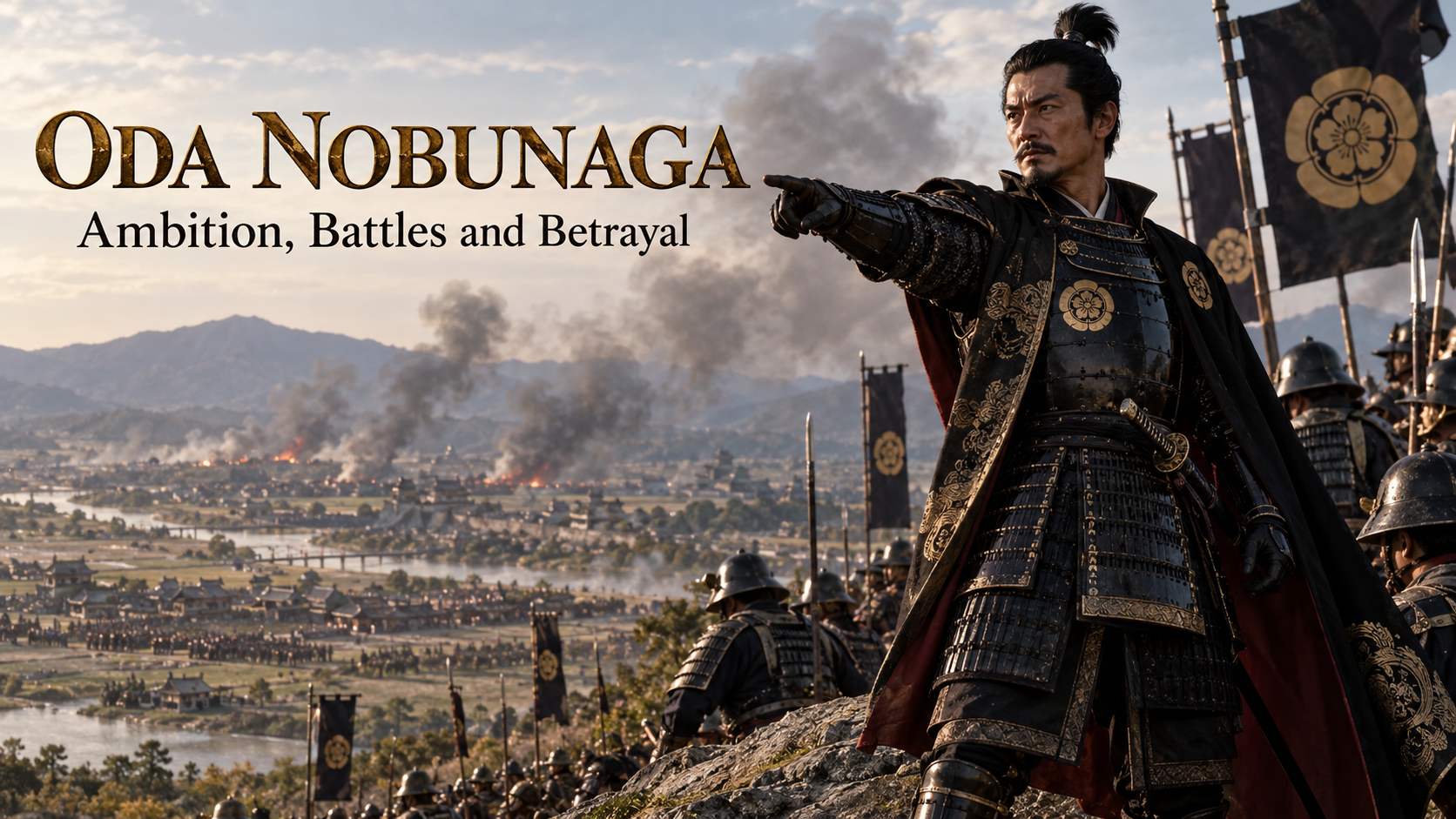
A sudden attack in the rain. Matchlock smoke drifting across a battlefield. A powerful warlord trapped inside a burning Kyoto temple. Few lives in Japanese history contain scenes as dramatic as that of Oda Nobunaga.
Born in 1534, Nobunaga rose from a regional warrior family to become one of the central figures in Japan’s sixteenth-century struggles for power. His victories helped reshape the country, yet he died before completing the work usually described as unification.
For overseas visitors, his story offers more than spectacular samurai battles. It connects the hills of Aichi, the castle landscape of Gifu, the shores of Lake Biwa and the streets of Kyoto. Following those connections makes Japan’s historic places easier to understand.
The images in this article are original historical illustrations. They imagine scenes from Nobunaga’s world rather than reproduce documented appearances or surviving buildings.
Okehazama: The Battle That Changed Nobunaga’s Future
In 1560, Imagawa Yoshimoto advanced into Owari, Nobunaga’s home territory in what is now Aichi Prefecture. Yoshimoto commanded the larger army, and Nobunaga faced a threat that could have ended his rise almost before it began.
Instead, Nobunaga struck Yoshimoto’s position at Okehazama. The attack killed the Imagawa commander and transformed the balance of power around Owari.
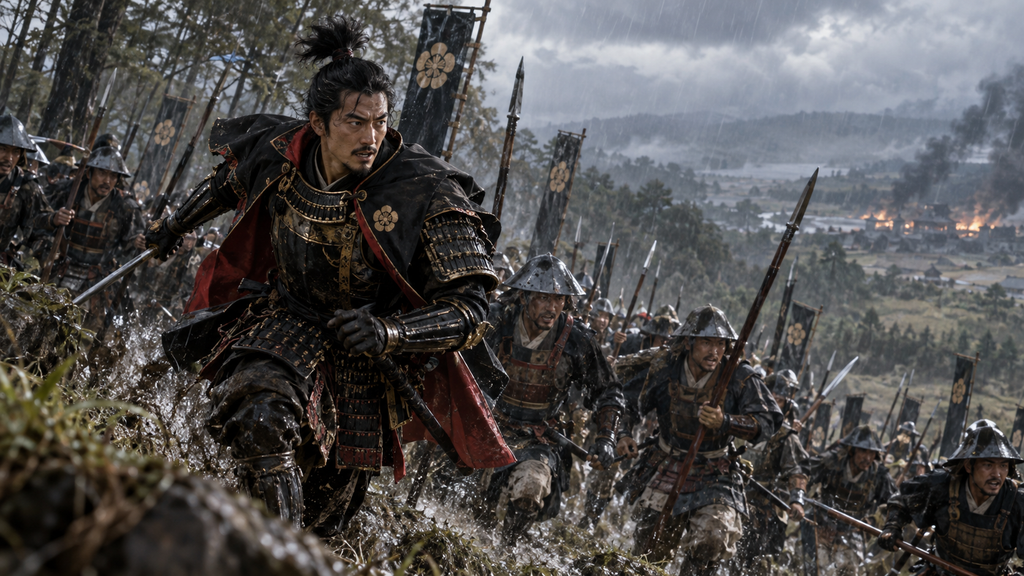
The familiar version emphasizes a thunderstorm, surprise and a daring attack against overwhelming odds. Exact troop numbers and the attack route deserve more caution than dramatic retellings usually allow. What matters most is the outcome: Yoshimoto died, and Nobunaga emerged as a dangerous regional power.
Travelers should also distinguish two commemorative locations: the traditional battlefield site in Toyoake and Okehazama Battlefield Park in Nagoya’s Midori Ward. They are separate places, so check the Japanese name before setting your route. See the official Aichi guides to Toyoake’s battlefield site and Nagoya’s battlefield park.
Who Was Oda Nobunaga?
Nobunaga was a daimyo, a territorial lord, during the Sengoku period. This was an age of competing military houses, shifting alliances and repeated warfare. Calling him simply a “samurai” is accurate but incomplete: he directed armies, appointed retainers, managed territories and negotiated with other centers of power.
He is commonly grouped with Toyotomi Hideyoshi and Tokugawa Ieyasu as one of Japan’s three great unifiers. That grouping describes a historical sequence, rather than a single shared plan. Hideyoshi continued the process after Nobunaga’s death; Ieyasu later established the Tokugawa shogunate.
A useful way to read Nobunaga’s story is to watch his problems grow with his success. Winning territory created new frontiers, new enemies and a greater need to trust ambitious subordinates.
Anegawa: Fighting Alongside Tokugawa Ieyasu
At the Battle of Anegawa in 1570, Nobunaga and Tokugawa Ieyasu fought the Azai and Asakura forces in present-day Shiga Prefecture.
The fighting brings an important relationship into focus. Ieyasu was an allied lord with his own interests and forces. Nobunaga’s expansion depended on cooperation as well as individual leadership.
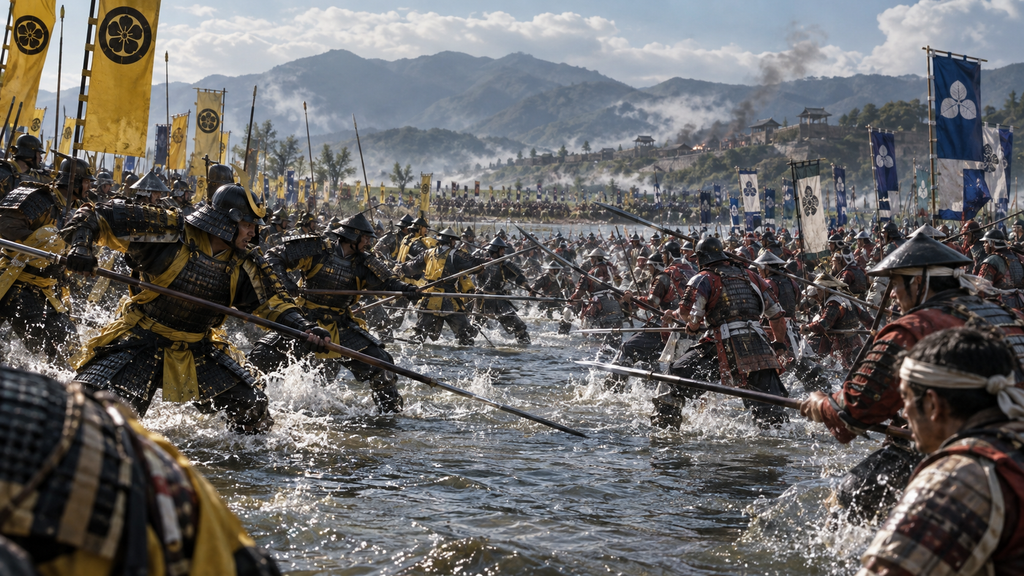
The Oda–Tokugawa victory did not immediately remove the Azai and Asakura threat. Campaigning continued, illustrating how misleading it can be to treat every famous battle as a complete turning point.
For readers picturing a sequence of elegant sword duels, this is also a useful correction. Large armies relied on organized groups of foot soldiers, spears, missile weapons and supporting work. The commanding warrior was only one part of the battlefield.
The Shiga tourism guide to Yokoyama Castle’s remains connects the surrounding hills with Nobunaga’s Anegawa campaign. Looking at this wider landscape helps explain why roads, heights and nearby fortifications mattered.
Nagashino: Firearms, Defenses and Preparation
In 1575, the allied armies of Nobunaga and Ieyasu defeated Takeda Katsuyori’s forces at Nagashino and Shitaragahara in present-day eastern Aichi.
The battle is famous for matchlock firearms and wooden defensive barriers. It is often presented as a dramatic encounter between gunmen and charging cavalry, but that image compresses a much more complicated engagement.
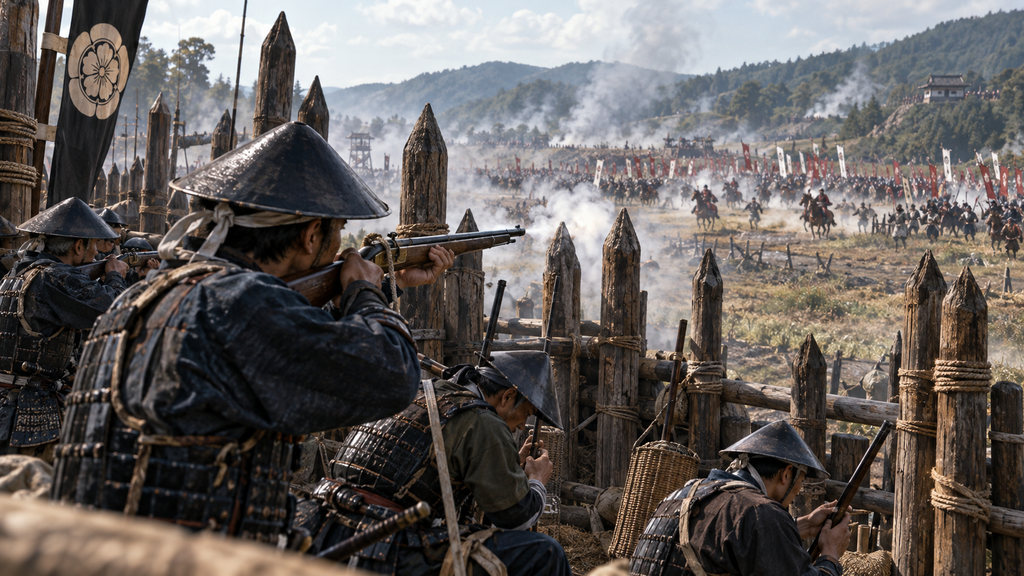
Nobunaga did not introduce guns to Japan. His importance lies partly in how firearms were incorporated into a wider military system. Soldiers needed weapons, ammunition, training, protection and coordination. A gun became more useful when the surrounding organization supported it.
The famous account of perfectly rotating ranks firing continuous volleys should not be treated as an uncontested description. Nor should the Takeda army be imagined as cavalry alone. For a visitor, the more reliable lesson is the relationship between terrain, defensive preparations and concentrated firepower.
Today, reconstructed wooden palisades help make the landscape legible. The official Aichi historical tourism page introduces the battlefield and its association with the Oda–Tokugawa victory. Remember that the barriers you see are reconstructions, while the surrounding ground supplies the connection to place.
How Nobunaga Built Power Beyond the Battlefield
Military success depended on resources. Food had to reach soldiers, supplies had to move between bases, and retainers had to carry out orders across expanding territories.
Nobunaga’s support for commerce belongs in that picture. Market policies associated with rakuichi and rakuza reduced particular commercial restrictions and privileges in designated places. They were not the invention of modern free trade, and their application varied.
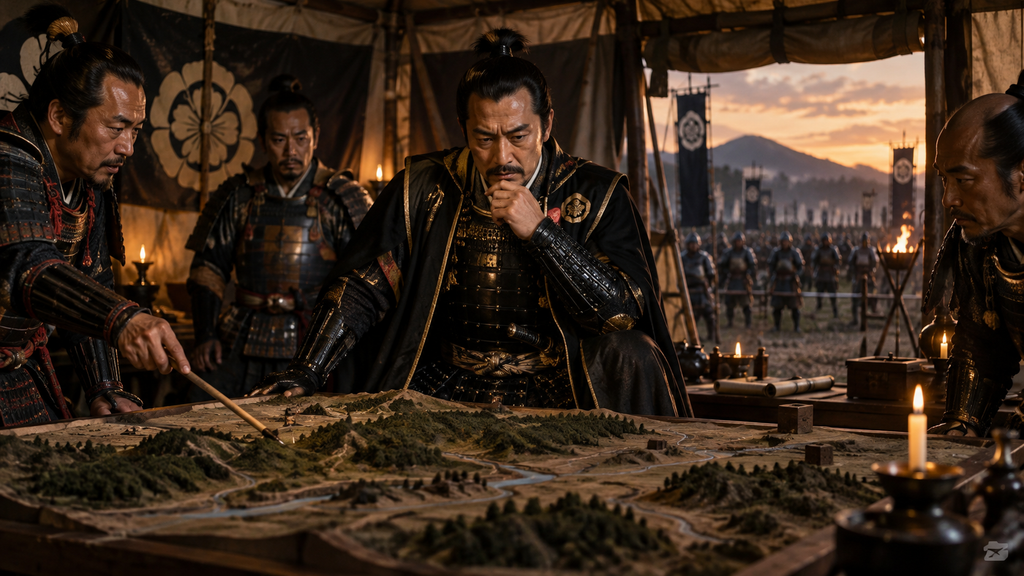
Gifu provides a tangible connection. Entokuji preserves a market edict associated with Nobunaga, allowing the story to move beyond swords and armor into the administration of a castle town. The official Entokuji guide introduces this surviving evidence.
This combination of warfare and governance helps explain his reach. A dramatic charge might win a battle; maintaining influence over towns, roads and people required repeated decisions long after the fighting stopped.
Honnoji: Betrayal and an Unfinished Ambition
In 1582, the forces of Nobunaga’s general Akechi Mitsuhide attacked him at Honnoji in Kyoto. Nobunaga died during the incident, abruptly ending his bid for wider control.
Why Mitsuhide rebelled remains debated. Personal resentment, political calculations and broader tensions all appear in explanations, but no single motive should be presented as settled fact.
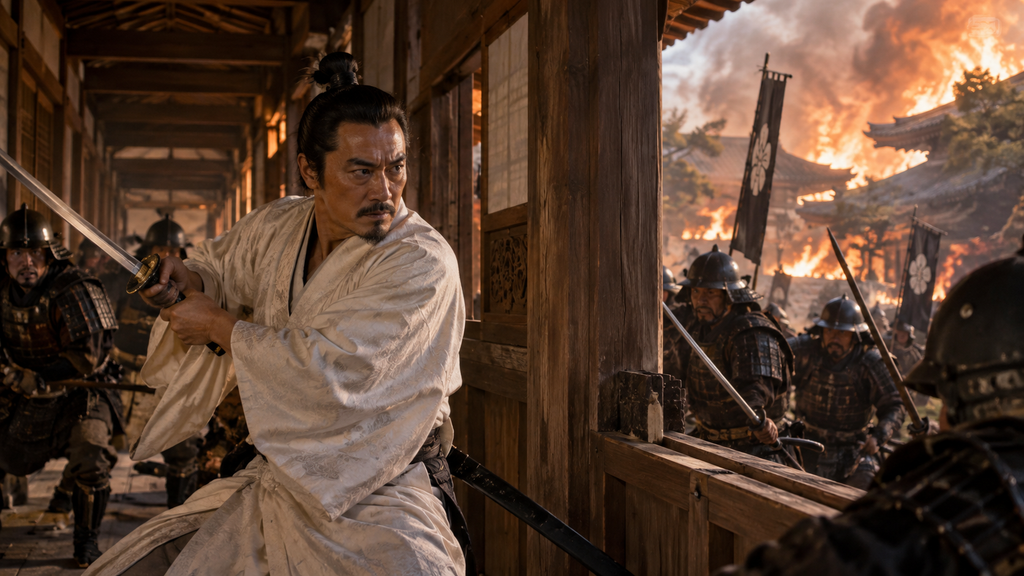
The episode is compelling because it exposes the limits of military power. Nobunaga’s position depended on commanders whose armies gave them the capacity to act independently. His success could not guarantee their loyalty.
There is an essential distinction for travelers: today’s Honnoji occupies a later location. The original incident site is elsewhere in central Kyoto. The city’s official guides distinguish the present temple from the former Honnoji site. Visiting both lets you separate a continuing religious institution from the location of the historical event.
Japanese Perspective: Why Nobunaga Remains Compelling
In Japanese popular culture, Nobunaga frequently appears as a fearless innovator, a ruthless conqueror or a leader impatient with convention. Those images reveal how later generations interpret him; they do not give us unrestricted access to his personality.
A Japanese perspective is especially useful when it connects that national reputation with local memory. In one town, visitors encounter a market document. Elsewhere, a battlefield marker, temple memorial or castle foundation carries the story. The same figure can represent commercial prosperity, political ambition and devastating violence.
His patronage of elite culture also complicates the warrior stereotype. Tea utensils, hospitality and impressive residences belonged to a world in which taste could communicate status and authority.
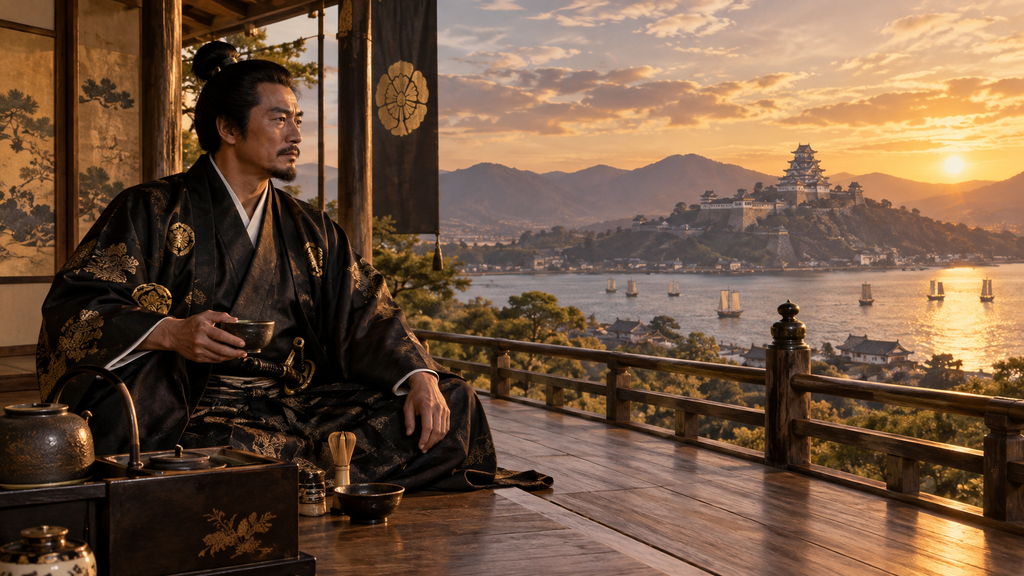
This article’s interpretation is that Nobunaga becomes more interesting when we hold those elements together. Admiration for his energy does not require overlooking the human costs of conquest. Equally, reducing him to cruelty makes it harder to understand the institutions, alliances and cultural practices that supported his power.
For more context, explore our Japanese history articles alongside the places associated with his life.
Where to Explore Oda Nobunaga’s Legacy
Aichi: Begin with Okehazama or Nagashino
Choose Okehazama if your main interest is Nobunaga’s early breakthrough. Choose Nagashino–Shitaragahara if you want to understand a battlefield through defensive features and terrain.
Treat them as separate excursions. Nagashino lies in eastern Aichi around Shinshiro, well away from the Nagoya-area Okehazama sites. Study local connections before committing to several stops in one day.
Gifu: A Castle Town and a Crucial Closure Update
Nobunaga made Gifu an important base after taking the castle in 1567. The present keep is a twentieth-century reconstruction.
Travel update, checked September 9, 2026: Gifu Castle’s keep is closed for renovation. The official tourism page currently announces a planned reopening in November 2027; the associated museum is also closed. Access restrictions affect parts of the summit area. Check the official Gifu Castle page before planning a mountain visit, and build your trip around available town-level sites during the closure.
Shiga: Walk Through Azuchi Castle’s Remains
Nobunaga began building Azuchi Castle in 1576 near Lake Biwa. Today the principal experience is its surviving stonework, foundations and hillside setting, rather than an intact palace.
Wear shoes suitable for uneven stone steps. Do not use the illustration above to judge what survives. Consult the official Azuchi Castle ruins guide for access information and admission arrangements before traveling.
Kyoto: Connect Honnoji’s Two Locations
The present temple and the former site suit a focused city walk. At each stop, ask a different question: what happened here, and how has it been remembered? Allow time for interpretation rather than expecting a preserved room from Nobunaga’s final hours.
Practical Planning Tips
Use Nagoya as a starting point for an Aichi-focused trip, and Kyoto for a Kyoto-and-Shiga itinerary. These are suggested planning bases, not a single fast route linking every site.
Keep battlefield days flexible. Local transport may require more planning than journeys between major cities. Carry water for exposed sites and check weather before climbing castle ruins. At temples, follow posted photography rules and remember that visitors may be sharing the space with worshippers.
Check official opening notices, transport schedules and admission charges shortly before visiting. For broader inspiration, browse our Japan travel guides.
FAQ
Did Oda Nobunaga unify Japan?
No. He greatly expanded his power and helped lay the foundations for later unification, but died in 1582 before completing it. Hideyoshi and Ieyasu belong to the subsequent stages of that story.
Was Nobunaga a samurai or a shogun?
He belonged to the warrior class and ruled as a daimyo. He did not become shogun.
What was his most famous battle?
Okehazama and Nagashino are both central to his reputation. Okehazama established him as a formidable opponent; Nagashino is particularly associated with firearms and defensive preparation.
Why did Akechi Mitsuhide betray him?
The motive remains uncertain. Treat a confident, single-cause explanation in a film or novel as storytelling rather than a settled historical conclusion.
Can I visit Nobunaga’s original castles?
You can visit associated castle sites, but distinguish surviving remains from later reconstructions. Azuchi is principally a ruins site, while Gifu’s reconstructed keep is currently closed for renovation.