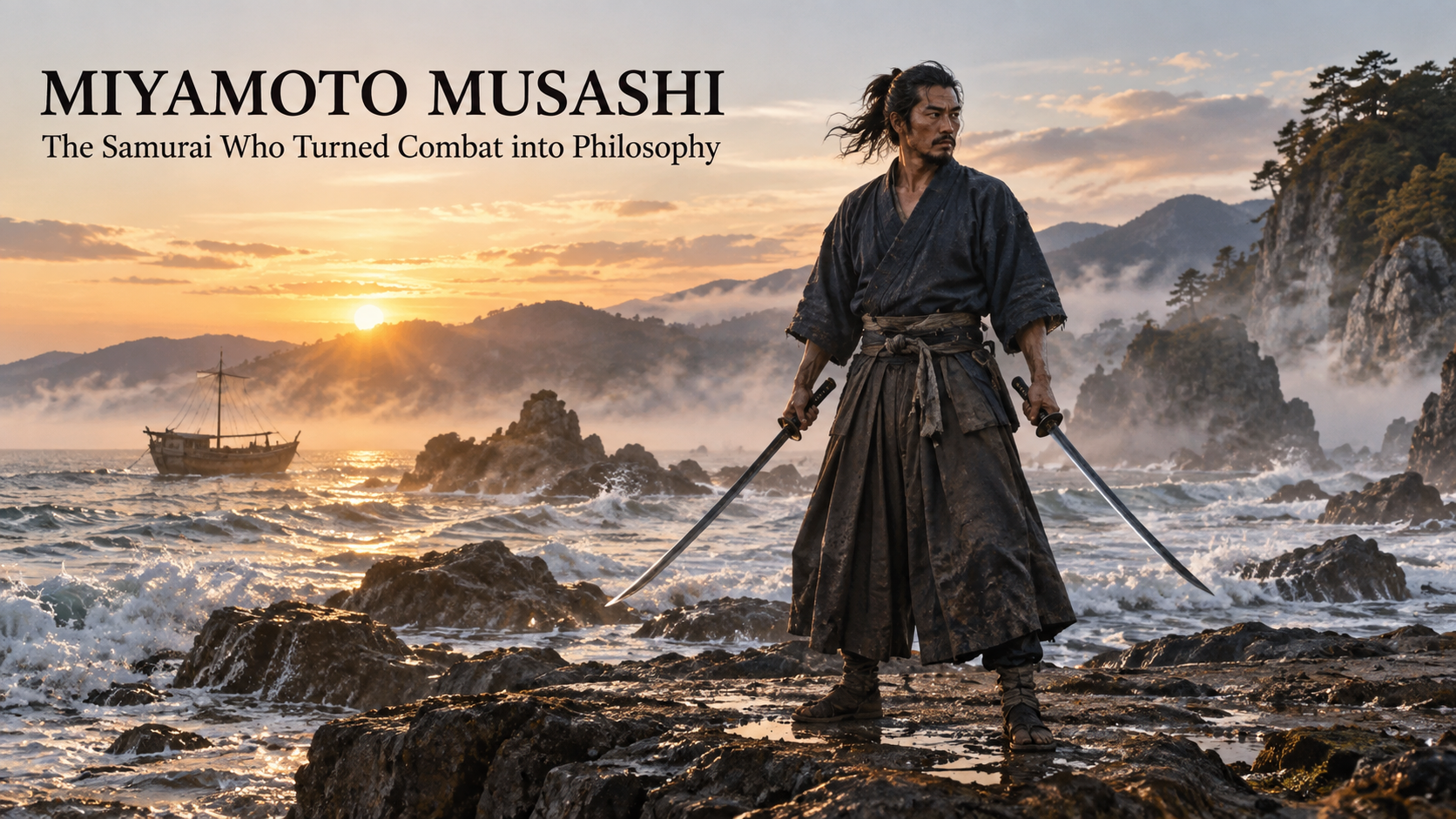
Miyamoto Musashi is often introduced as Japan’s greatest swordsman: a wandering warrior who survived dozens of duels, defeated the celebrated Sasaki Kojiro and developed a style that used two swords at once. That description is exciting, but it is only the beginning.
Musashi was also a strategist, writer and artist. His life stretched across a turning point in Japanese history, when the wars of the Sengoku period were giving way to the more stable rule of the Tokugawa shogunate. He learned in an age of violence, yet the work that made him immortal was not a heroic war tale. It was a compact study of judgment, rhythm, perception and self-mastery: The Book of Five Rings.
For travelers, Musashi’s story is unusually tangible. You can visit mountain country associated with his youth in Okayama, walk through a Kyoto neighborhood linked to his most dangerous confrontations, cross the water to Ganryujima and enter the quiet cave near Kumamoto where he spent part of his final years.
This guide explores the man behind the legend—and explains what Japanese readers may hear in his story that can be lost when Musashi is presented simply as an unbeatable warrior.
Who Was Miyamoto Musashi?
Miyamoto Musashi lived from around 1584 to 1645. Even the basic outline of his youth is surrounded by uncertainty. Mimasaka in present-day Okayama Prefecture is widely promoted as his birthplace, while other traditions connect his birth to neighboring Harima. The uncertainty is important: Musashi lived before modern recordkeeping, and later novels, plays and films added memorable details that are not always supported by contemporary evidence.
In The Book of Five Rings, Musashi wrote that he had fought his first duel at the age of thirteen. He later traveled as a warrior undertaking musha shugyo—a period of training through travel, hardship and encounters with other martial artists. Rather than remaining permanently attached to one castle lord, he built his reputation through experience.
Musashi is often described as a ronin, a masterless samurai. That word can sound romantic in English, but historically it could also suggest instability. A warrior without a secure lord and income lived outside the safest path in a status-conscious society. Musashi’s wandering therefore represented freedom, but also risk.
History and Legend Are Not Always the Same
Stories claim that Musashi fought more than sixty contests without defeat. His reputation as a brilliant swordsman is not in doubt, but the exact number, sequence and details of those encounters are difficult to verify. The most responsible way to enjoy his story is not to reject the legends, but to recognize them as part of his cultural afterlife.
Japanese historical heroes often exist in two overlapping forms: the documented person and the character remembered through storytelling. Musashi is one of the clearest examples.
The Kyoto Duels and the Making of a Legend
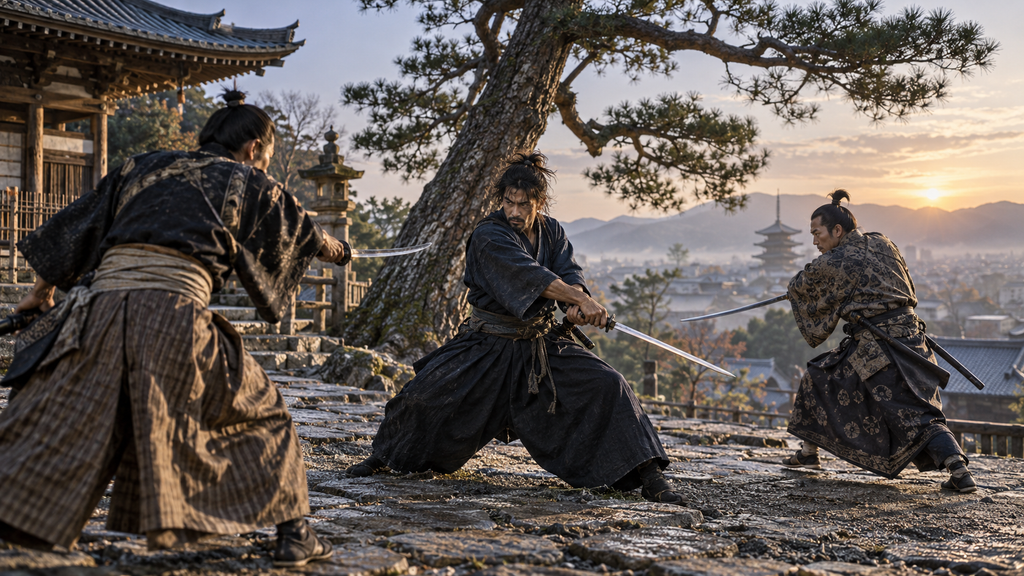
One famous cycle of stories concerns Musashi’s clashes with the Yoshioka school in Kyoto. The Yoshioka had a strong reputation as martial instructors, and later accounts describe Musashi challenging its leading members before facing a larger group near Ichijoji.
The exact course of these battles is disputed. However, the stories express qualities that remain central to the Musashi image: refusing to fight according to an opponent’s preferred pattern, controlling distance and timing, and treating the entire environment as part of the contest.
In the best-known version of the Ichijoji encounter, Musashi arrived early, hid near a pine tree and attacked at the moment that gave him the advantage. This can surprise readers expecting a formal, face-to-face display of honor. Yet Musashi’s strategy was not about looking noble. It was about understanding the real conditions of danger.
The Duel on Ganryujima: Musashi vs. Sasaki Kojiro
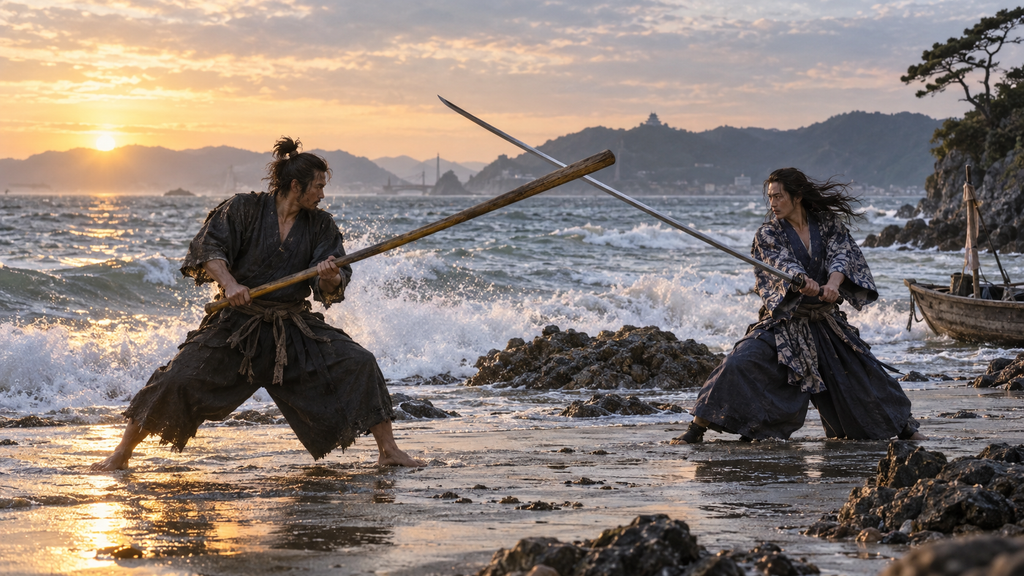
Musashi’s most famous duel took place on an island in the Kanmon Strait, traditionally dated to 1612. His opponent was Sasaki Kojiro, a renowned swordsman associated with an unusually long blade. The island’s official name was Funashima, but it became widely known as Ganryujima after Kojiro’s martial tradition.
The popular story is cinematic. Musashi supposedly arrived late by boat, carved a long wooden sword from an oar and stepped ashore to face Kojiro. During the confrontation, he used the weapon’s reach and his command of timing to defeat his rival.
Some details vary among later sources, including why Musashi was late and exactly how the final exchange unfolded. Nevertheless, the story illustrates a principle closely associated with him: victory begins before blades meet. Weapon choice, psychology, sunlight, terrain and rhythm can all shape an encounter.
Modern Ganryujima is peaceful rather than dramatic. Visitors can see statues of the two swordsmen and look across the busy strait between Honshu and Kyushu. The contrast is part of the experience: a legendary confrontation is remembered on a small, windswept island surrounded by ordinary ships and city life.
Niten Ichi-ryu: Why Musashi Used Two Swords
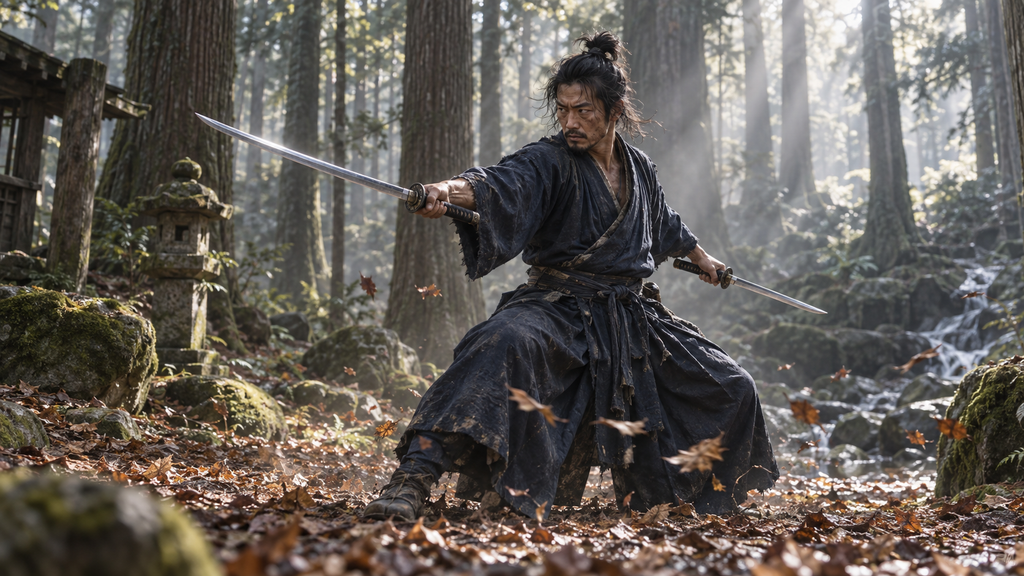
Musashi is closely associated with Niten Ichi-ryu, usually translated as “the school of two heavens as one.” Its most recognizable feature is the coordinated use of the long sword and short sword.
This was unusual because samurai commonly carried two swords but often used the long sword with both hands. Musashi questioned the habit of leaving one weapon unused. He argued that a warrior should be able to handle weapons flexibly and avoid becoming dependent on a single tool or fixed method.
The idea is subtler than spectacular “dual wielding.” A sword in each hand requires balance, control of space and freedom from unnecessary tension. More broadly, it reflects Musashi’s dislike of rigid attachment. Technique mattered, but a technique became dangerous if the practitioner could not adapt when conditions changed.
Japanese Perspective: What “Kensei” Really Suggests
Musashi is frequently called a kensei, or “sword saint.” The English translation can sound religious or supernatural, but the Japanese term is better understood as an exceptional title of respect for a swordsman whose skill appeared to transcend ordinary mastery.
From a Japanese perspective, Musashi’s appeal is not only that he won. It is that he transformed severe practice into a way of seeing. This connects with the concept of do—the “way” found in words such as kendo, judo and shodo (calligraphy). A discipline can begin as a practical skill and gradually become a lifelong path of character, attention and refinement.
It is also helpful not to force later romantic ideas of bushido onto every event in Musashi’s life. He lived close to the chaotic end of the warring-states era. His world rewarded survival, flexibility and service, not merely the polished etiquette associated with later samurai culture.
Musashi can appear rough, calculating and fiercely independent. Yet his mature writings repeatedly turn the reader away from vanity. The goal is not to pose like a warrior. It is to observe clearly, train honestly and respond without confusion.
The Book of Five Rings: Strategy Beyond Swordsmanship
Late in life, Musashi lived in Kumamoto under the patronage of the Hosokawa domain. He is traditionally associated with composing Go Rin no Sho, or The Book of Five Rings, while staying at Reigando Cave near Unganzenji Temple.
The work is divided into five sections named Earth, Water, Fire, Wind and Void. Earth establishes the foundation of strategy. Water emphasizes adaptability. Fire discusses conflict. Wind examines other schools, while Void points toward perception free from illusion and attachment.
Modern readers often apply the book to business, sport or personal development. That can be useful, but it should not obscure the original context: Musashi was writing about mortal combat and martial training. His lessons are powerful precisely because observation and error carried extreme consequences in his world.
One of his most enduring ideas is to see both the large picture and the smallest detail. In Japanese arts, mastery is rarely presented as a sudden flash of inspiration. It is built through repetition until the body can act without being trapped by conscious hesitation.
Musashi the Artist: The Other Side of the Swordsman
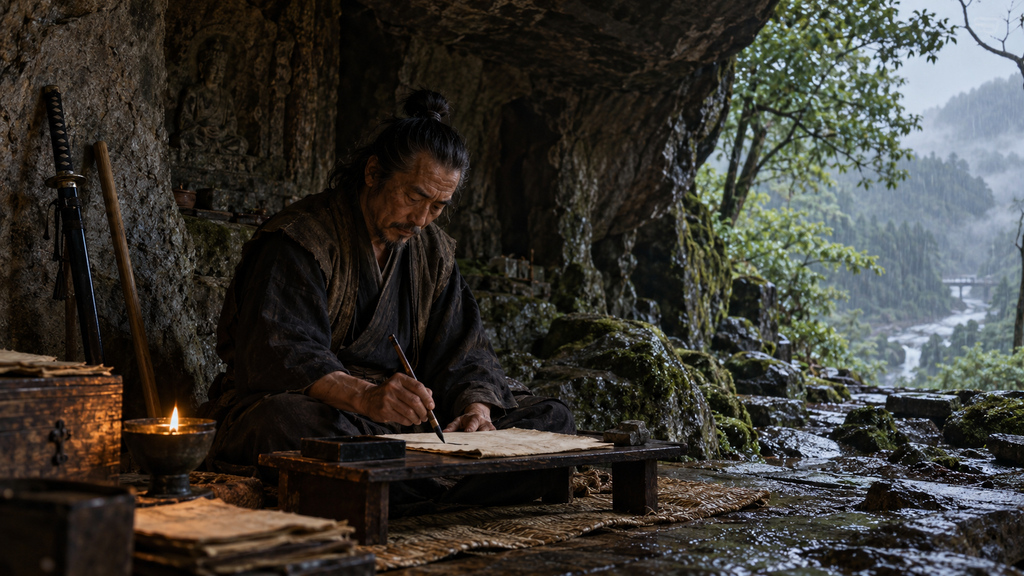
The image of Musashi as a wild fighter is incomplete. He also practiced ink painting, calligraphy and other arts. Works attributed to him often favor restrained brushwork and strong use of empty space.
This is not a contradiction. Swordsmanship and ink painting both demand decisive movement. A brushstroke cannot be endlessly corrected, just as hesitation in a duel could be fatal. The hand must move with commitment, but not stiffness.
This relationship between martial and artistic practice is a particularly Japanese dimension of Musashi’s legacy. Strength is not only physical force. It includes knowing when to move, what to leave out and how to remain composed.
How to Visit Places Connected to Miyamoto Musashi
Musashi’s life cannot be reduced to one destination. The following places create a rewarding history route across western Japan.
1. Miyamoto Village Area, Mimasaka, Okayama
Northern Okayama preserves several sites associated with Musashi’s early life, including Musashi Shrine and a grave traditionally connected to him and his family. The quiet rural setting helps travelers imagine the distance between Musashi’s formative world and the political centers of Kyoto and Osaka.
The area is much easier to explore with careful rail planning or a rental car. Travelers using public transport should check current Chizu Express and local bus schedules before departure.
2. Ichijoji Sagarimatsu, Kyoto
This northeastern Kyoto neighborhood is linked to Musashi’s legendary confrontation with the Yoshioka school. The modern site is modest, so visit for historical atmosphere rather than a large museum experience. It combines well with nearby temples such as Shisendo and Enkoji.
3. Ganryujima, Yamaguchi
Boats commonly reach Ganryujima from the Shimonoseki side of the Kanmon Strait, with some services also linked to the Mojiko area. The crossing is short, but schedules can change because of weather or operations. Check the official timetable on the day of travel.
Allow roughly half a day when combining the island with Karato Market, Akama Shrine or Mojiko Retro. Ganryujima itself is compact and best enjoyed slowly, with time to watch the strait.
4. Reigando Cave and Unganzenji Temple, Kumamoto
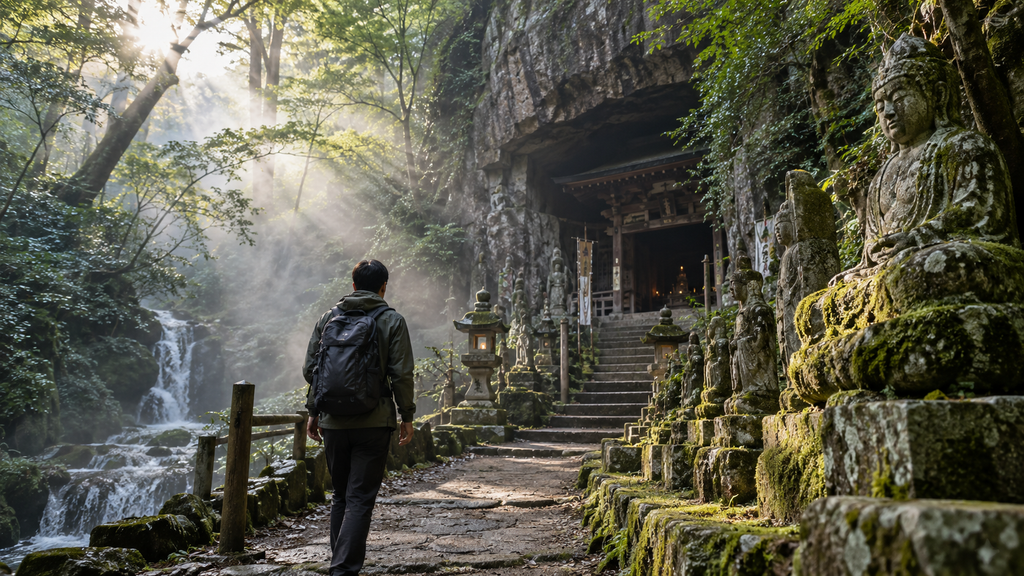
Reigando is the most contemplative Musashi destination. The forest path, temple grounds and rows of weathered stone figures create a mood very different from the excitement of Ganryujima.
The cave lies outside central Kumamoto and is less convenient by public transport. A car or taxi offers the simplest journey. Wear comfortable shoes, allow time for stone steps and confirm opening information before visiting.
5. Shimada Museum of Art and Musashizuka Park, Kumamoto
The small Shimada Museum of Art is known for a collection focused heavily on Musashi-related materials. Musashizuka Park preserves one of the sites said to be his burial place. Together with Reigando, they reveal how strongly Kumamoto shaped the final chapter of his life.
Suggested Miyamoto Musashi Itineraries
One-Day Chugoku Route
- Morning: Explore Shimonoseki and the Kanmon waterfront.
- Midday: Take the boat to Ganryujima.
- Afternoon: Visit Akama Shrine or cross to Mojiko Retro.
- Evening: Try Shimonoseki seafood, especially local fugu cuisine from a reputable restaurant.
Two-Day Kumamoto Route
- Day 1: Visit Kumamoto Castle and the Shimada Museum of Art.
- Day 2: Travel to Unganzenji Temple and Reigando Cave, then stop at Musashizuka Park if transport allows.
Longer Musashi Journey
Travelers with five to seven days can connect Mimasaka, Kyoto, Shimonoseki and Kumamoto. The route is geographically spread out, but it tells a satisfying story: uncertain beginnings, dangerous contests, the famous island duel and a final period devoted to strategy and art.
Practical Travel Tips
- Best seasons: Spring and autumn offer comfortable walking weather. Summer can be hot and humid, while winter conditions make rural access less predictable.
- Recommended trip length: One day for a single Musashi destination; five to seven days for a multi-region journey.
- Transport: Trains work well between major cities, but a rental car is helpful around rural Mimasaka and Reigando.
- Before you go: Recheck ferry times, museum closing days, admission fees and local bus schedules on official websites.
- Etiquette: Reigando, Unganzenji and Musashi Shrine are cultural or religious places, not film sets. Keep voices low and follow photography signs.
- Reading tip: A short introduction to The Book of Five Rings before the trip will make the sites more meaningful.
FAQ About Miyamoto Musashi
Was Miyamoto Musashi a real samurai?
Yes. Musashi was a historical swordsman, strategist and artist who lived around 1584–1645. However, many popular details about his duels come from later accounts and literary retellings.
Did Miyamoto Musashi really fight with two swords?
Musashi founded a martial tradition associated with using the long and short swords together. His deeper lesson was flexibility: a warrior should understand different weapons and not become dependent on one fixed method.
Did Musashi really carve a sword from an oar?
The wooden sword carved from an oar is the best-known version of the Ganryujima story, but historians cannot verify every detail of the duel with certainty. It is best treated as a powerful tradition rather than an undisputed fact.
What is The Book of Five Rings about?
It is a work on martial strategy, perception, timing, training and adaptability. Although modern readers apply it to many fields, it was written from the perspective of a highly experienced swordsman.
Where is the best place to learn about Musashi in Japan?
Choose according to your interest. Ganryujima is best for the legendary duel, Mimasaka for his origins, Kyoto for the Yoshioka stories and Kumamoto for his writing, art and final years.
Is Ganryujima worth visiting?
Yes for travelers interested in samurai history, the Kanmon Strait or atmospheric historic sites. It is small and quiet, so combine it with Shimonoseki or Mojiko rather than expecting a full-day attraction.
Why Miyamoto Musashi Still Matters
Musashi survives because his story contains more than victory. He moved from youthful combat toward a mature search for clarity. His two swords became symbols of flexibility; his paintings showed discipline without excess; and his final book asked readers to look beyond appearance.
For international visitors, following Musashi through Japan also reveals how history is remembered here. A quiet pine tree, an island statue, a rural shrine and a dark cave can carry as much emotional weight as a grand castle. The traveler supplies part of the imagination.
Perhaps that is the most fitting way to meet Miyamoto Musashi—not as a flawless action hero, but as a difficult, evolving person who spent a lifetime testing how to see and act without hesitation.
Related Japan Guides
- Explore more destinations across Japan
- Discover samurai, ninja and major figures in Japanese history
- Aomori Travel Guide for First-Time Visitors
- Hokkaido Travel Guide for First-Time Visitors
Editorial Fact-Check Notes (Do Not Need to Publish)
- Treat Musashi’s birthplace as disputed. Mimasaka is a strong travel angle and is officially promoted by Okayama tourism, but avoid stating it as universally settled fact.
- Details of the Yoshioka encounters, Musashi’s lateness at Ganryujima and the oar-carved weapon belong partly to later tradition; the article labels them accordingly.
- Confirm current ferry, museum, temple and public-transport details shortly before publication.
- Official planning references:
- Okayama Tourism — Musashi Shrine: https://www.okayama-japan.jp/en/spot/10609
- Shimonoseki Tourism — Ganryujima: https://shimonoseki.travel/844-2/
- Kumamoto City Guide — Reigando Cave: https://kumamoto-guide.jp/en/spots/detail/109
- Kumamoto City Guide — Shimada Museum of Art: https://kumamoto-guide.jp/en/spots/detail/21
- Kumamoto City Guide — Musashizuka Park: https://kumamoto-guide.jp/en/spots/detail/56